
We’ve all been there: staring at a goal, knowing exactly what steps to take, and yet… staying exactly where we are.
Usually, this is when the inner critic kicks in, labeling us as “lazy,” “unmotivated,” or “disciplined-challenged.”
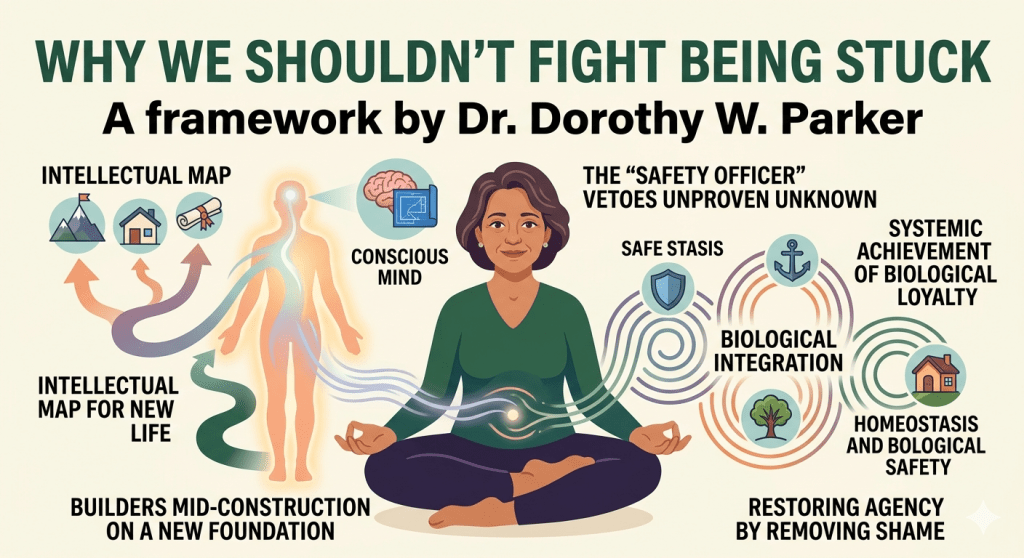
But what if your inability to move forward isn’t a flaw? What if it’s actually a systemic achievement?
Redefining the “Stuck” Narrative
Traditional self-help tells us that stagnation is a character defect. Dr. Dorothy W. Parker’s research turns this on its head. When we judge ourselves for being stuck, we aren’t just being mean, we’re being scientifically inaccurate.
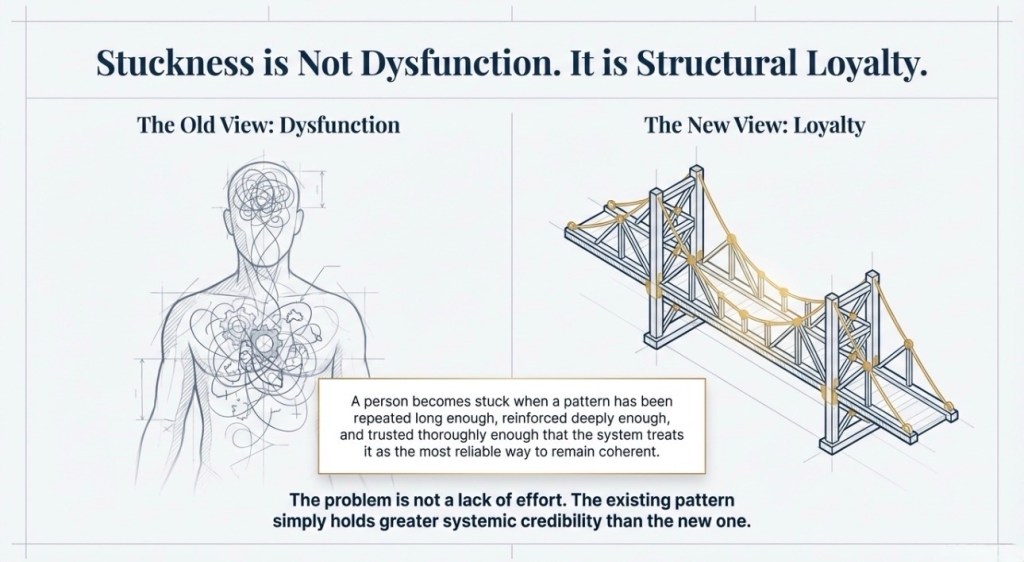
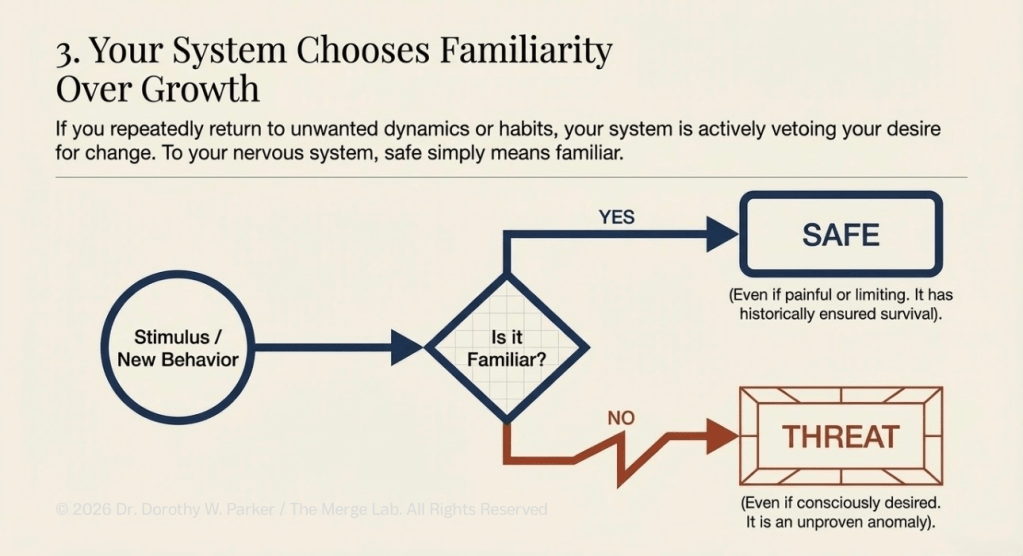
According to Dr. Parker, “stuckness” is a state of biological loyalty. Your nervous system isn’t trying to ruin your life; it is functioning with profound precision to maintain a “structural agreement” that has kept you safe until now. To your biology, the familiar, even if it’s painful or limiting, is synonymous with survival.
The “Safety Officer” vs. The Intellectual Map
Have you ever felt like you have the “intellectual map” for a new life, but your legs won’t walk the path? This is what Dr. Parker calls a Conflict of Consistencies.
- Your Mind: Sees the potential of a new career, a healthier relationship, or a new habit.
- Your Body’s “Safety Officer“: Sees an unproven unknown. To a nervous system primed for protection, “new” equals “destabilizing threat.”
You aren’t unmotivated. You are experiencing the intense friction of waiting for a new pattern to become reliable enough for your body to trust it. You aren’t failing; you are simply mid-construction on a new foundation.
Why “Trying Harder” Often Backfires
If we view ourselves as “broken machines,” our instinct is to use force. We apply shame, urgency, and pressure to “fix” the problem.
However, your nervous system interprets high-pressure force as a secondary threat. When you scream at yourself to “just do it,” your Safety Officer panics and retreats even further into the old, stuck baseline to protect you from yourself.
The shift: We must stop treating ourselves as victims of bad choices and start seeing ourselves as builders.
Moving Forward Without the Fight
By removing the weight of shame, we restore our agency. We stop fighting our biology and start collaborating with it.
Instead of forcing a breakthrough, we focus on making the new path feel “familiar” enough to call home.
Next time you feel paralyzed, remember: You aren’t broken. Your system is just doing its job a little too well. Give it permission to feel safe in the shift.
Summary
We often view stagnation as a moral failure or a lack of willpower. Dr. Dorothy W. Parker’s framework suggests that being “stuck” is actually a sophisticated biological achievement rather than a character flaw.
1. Stagnation is “Biological Loyalty”
Your nervous system isn’t broken; it’s being incredibly loyal to what has kept you alive so far. It prioritizes homeostasis (the familiar) over the unknown because the familiar, even if it’s painful, is perceived as “safe.”
2. The “Conflict of Consistencies”
Stuckness occurs when your intellectual map (the conscious desire to change) outpaces your biological integration (the body’s readiness to feel safe in that change). You aren’t unmotivated; you are experiencing the friction of a “Safety Officer” vetoing an unproven new path.
3. Force Causes Retreat
When we use shame, judgment, or “tough love” to force ourselves out of a rut, we trigger a survival response. The nervous system perceives this internal pressure as a threat and retreats deeper into the old, stuck pattern to protect itself.
4. From “Broken Machine” to “Builder”
To move forward, we must stop treating ourselves as faulty equipment that needs fixing.
Instead, we should see ourselves as builders mid-construction. The goal isn’t to “break” a habit, but to make a new pattern reliable and familiar enough for the body to finally trust it.



 Transform
Leave a comment