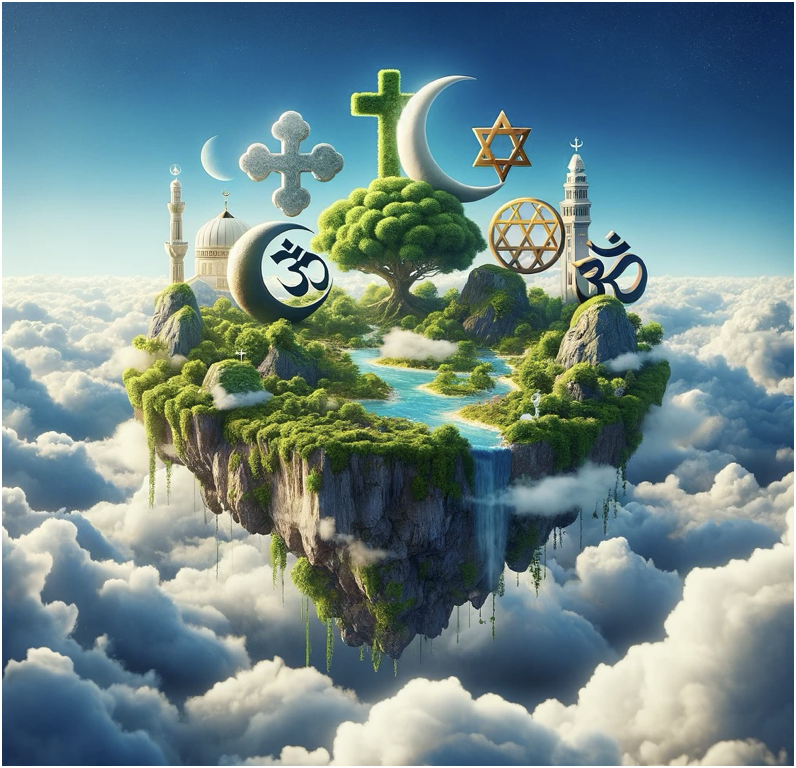
“It’s worth noting that while religious concepts may be perceived as eternal, interpretations and understandings of these concepts can evolve. The fantasy that abstract religious concepts are eternal realities can be seen as an illiterate understanding of abstract concepts. Religion, in its essence, is fantastical, and tens of thousands of different expressions can be found in Christianity alone. According to Wesleyan College, there are over 33,089 denominations in Christianity alone. Not to mention that within those denominations, there are further declarations of sects in Christian denominations.
Religion often incorporates fantastical themes, elements, and narratives. Many religious traditions contain stories, myths, and supernatural elements beyond ordinary human experience. These fantastical themes serve various purposes within religious contexts.
1. Symbolism and Allegory: Fantastical themes can be used as symbolic representations of complex ideas, moral lessons, or spiritual truths. For example, in Christianity, the concept of the resurrection of Jesus can be seen as a symbolic representation of the triumph of life over death, offering hope and redemption.
2. Encouraging Imagination and Wonder: Fantastical elements in religious texts and teachings can inspire wonder and awe. They can evoke a sense of mystery and invite individuals to explore the depths of their faith and spirituality.
3. Transcendence and the Divine: Fantastical themes often depict encounters with the divine or supernatural realms. They can convey the idea that there are realities beyond the physical world and offer a glimpse into the transcendent nature of existence.
4. Cultural and Historical Significance: Fantastical narratives within religious traditions often have cultural and historical significance. They can reflect the beliefs, values, and experiences of a particular community or serve as a cultural touchstone that unifies and guides the community.
We can see the fantastical allegorical nature of religion in its purest form in many timeless religious favorites.
The following stories are excellent examples of religious texts incorporating fantastical and allegorical elements to convey deeper spiritual or moral truths. Let’s briefly explore some of them:
1. “Pilgrim’s Progress”: Written by John Bunyan, this Christian allegory follows the journey of a character named Christian as he travels from the City of Destruction to the Celestial City. It uses vivid imagery and fantastical encounters to explore the challenges and joys of the Christian life.
2. “The Book of Genesis”: The Bible’s first book, Genesis, contains numerous stories with allegorical elements, such as the world’s creation, the fall of Adam and Eve, the story of Noah’s Ark, and the Tower of Babel. These stories use metaphors and symbolism to convey theological and moral messages.
3. The Four Gospels: Matthew, Mark, Luke, and John in the New Testament present the life, teachings, and miracles of Jesus Christ. They contain parables, miracles, and symbolic events illustrating profound spiritual truths.
4. “The Book of Revelation”: The final book of the Bible, Revelation, is filled with vivid and fantastical imagery. It is an apocalyptic work that uses symbolic language to depict the battle between good and evil, the end of times, and the ultimate victory of God.
5. “The Book of Ezekiel”: This book in the Old Testament contains prophetic visions that include fantastical imagery, such as the vision of a heavenly chariot and the valley of dry bones. These visions convey spiritual messages and the relationship between God and humanity.
6. “Hinds Feet In High Places”: Written by Hannah Hurnard, this allegorical novel follows the character Much-Afraid on her journey to the High Places. It uses fantastical elements and characters to explore the themes of faith, trust, and personal growth.
7. “The Chronicles of Narnia”: Written by C.S. Lewis, this series of fantasy novels incorporates Christian symbolism and allegory. Through children’s adventures in the magical land of Narnia, Lewis explores spiritual themes, redemption, and the nature of faith.
These stories and texts showcase how religious traditions often utilize fantastical and allegorical elements to convey profound truths, stimulate imagination, and encourage contemplation and personal growth. They invite readers to delve into deeper meanings and engage with the spiritual dimensions of life.
It’s important to note that the fantastical themes within religious contexts are not meant to be taken literally as factual accounts. Instead, they are often understood as metaphorical or symbolic expressions of deeper truths and concepts. Individuals and religious communities may interpret these themes differently, allowing for a rich, diverse range of beliefs and understandings within a religious tradition.
Perceiving religious concepts as eternal does not necessarily mean their interpretations and understandings remain stagnant. While certain religious teachings and principles may be considered timeless or eternal in the sense that they have been passed down through generations, the interpretations and understanding of these concepts can and do evolve.
Religious concepts are often expressed through symbolic language, parables, and metaphorical narratives. We discuss this at the beginning of this chapter. These abstract representations allow for various interpretations and understandings. Individuals, cultures, and historical contexts may interpret religious teachings differently, leading to a rich fabric of beliefs and practices within a given religion.
Cultural shifts, societal changes, scientific advancements, and philosophical developments can influence interpretations. As human knowledge expands and societies progress, new perspectives and understandings may emerge. This expansion does not invalidate the core principles or insights of religious concepts but reflects the dynamic nature of human interpretation and understanding.
Claiming that abstract religious concepts are literal and unchanging realities can be seen as an illiterate understanding because it overlooks the nuanced and evolving nature of these concepts. It disregards the potential for growth, adaptation, and the deepening of understanding by engaging with religious teachings critically and reflectively.
By recognizing the evolving nature of interpretations, individuals and communities can engage in meaningful dialogue, explore new insights, and foster a deeper understanding of religious concepts and their relevance in contemporary contexts.
Religious teachings often involve complex metaphors, symbols, and allegories that attempt to convey profound truths about the nature of existence, morality, and spirituality. However, these concepts are not meant to be taken literally as concrete, unchanging realities. Instead, they serve as tools to inspire contemplation, foster personal growth, and encourage individuals to explore their understanding of the divine.”
Religious beliefs are often considered abstract because they deal with concepts that are beyond the realm of direct sensory experience. They involve ideas about deities, the nature of the universe, morality, the afterlife, and the purpose of human existence, among other things.
Religious beliefs are not typically based on empirical evidence or scientific proof. Instead, they rely on faith, personal experiences, cultural traditions, and spiritual insights. These beliefs are often expressed through metaphorical language, symbolism, and allegory.
For example, religious texts often use parables or stories to convey deeper truths. These stories may not be meant to be taken literally but rather as vehicles for conveying moral lessons or spiritual insights. The abstract nature of religious beliefs allows for multiple interpretations and understandings, as different individuals and cultures may have unique perspectives on these concepts.
Sense of Purpose in Religious Practice
It’s important to note that the abstract nature of religious beliefs doesn’t diminish their significance or impact. They can provide individuals with a sense of purpose, meaning, community, and guidance in navigating the complexities of life. The abstract nature allows flexibility and adaptability, as interpretations can evolve to accommodate changing social, cultural, and intellectual contexts.
In this context, “sense” refers to an individual’s perception, understanding, or awareness of something. It encompasses the ability to comprehend or make meaning of a particular aspect of life or experience.
Having a “sense” of purpose implies that individuals can recognize or discern the purpose or meaning behind their actions, choices, or existence. It involves a subjective understanding or feeling that provides individuals with a sense of direction, significance, or fulfillment in their lives.
This sense is often derived from personal values, beliefs, aspirations, and experiences. It can be influenced by cultural, social, and individual factors and may evolve as individuals gain new insights or undergo personal growth.
The term “sense” in the context of having a sense of purpose refers to an individual’s perception or understanding of the purpose or meaning behind their actions, choices, or existence. It represents their subjective awareness of the direction and significance of their life.
Having a sense of purpose in the context of religion refers to having a clear understanding of the direction, meaning, and significance of one’s life. It involves having a reason or goal that gives a sense of fulfillment and motivation.
For many people, a sense of purpose is closely linked to their values, passions, and aspirations. The driving force guides their actions, decisions, and choices. When individuals have a strong sense of purpose, they often feel a deep sense of meaning and fulfillment.
Having a sense of purpose can provide numerous benefits. It can give individuals a sense of direction and clarity, helping them make decisions that align with their values and long-term goals. It can also provide motivation and resilience during challenging times, as having a clear purpose can provide a sense of determination and perseverance.
In a broader context, a sense of purpose can extend beyond personal goals and aspirations. It can also involve a desire to contribute to something greater than oneself, such as positively impacting society, helping others, or pursuing a higher spiritual or philosophical calling.
Ultimately, a sense of purpose is a deeply personal and subjective experience. It can vary from person to person based on their unique values, beliefs, and life experiences. It is a powerful force that can bring fulfillment, satisfaction, and a sense of meaning to one’s life.
Coming Soon
Excerpt From
The Fantasy Island of Religion: Where Religion is Disconnected From Reality
Dorothy W. Parker, M.A.
This material may be protected by copyright.




 Transform
Leave a comment